SEO Start here
What SEO is, and what it can't promise
Search engines find, store and show pages in three stages. Here is what SEO can change at each one, what it cannot promise, and where a local business should start.
i · a burst pipe at 2 a.m., a phone in hand
What SEO means, in one sentence
Picture a homeowner watching water spread across the kitchen floor. They grab a phone and search for a plumber. Whoever shows up on that screen is likely to get the call.
SEO is how a business tries to be on that screen. Put simply, SEO means giving your website a fair chance to be found when a nearby customer searches for what you do.
Built In, a tech industry publication, defines it as improving a site's organic visibility in search engines. Michigan Technological University describes it in terms of content: creating and improving pages that are relevant and authoritative.
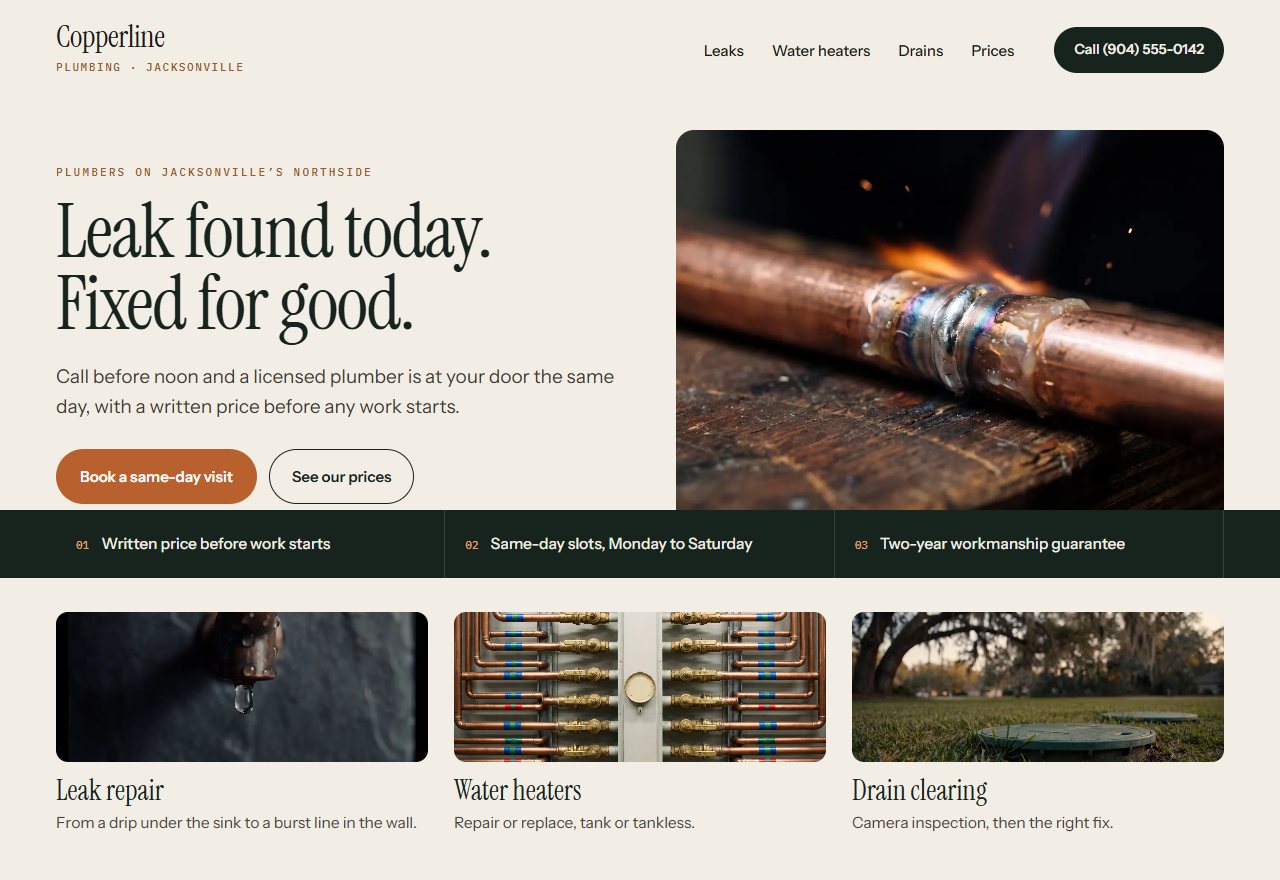
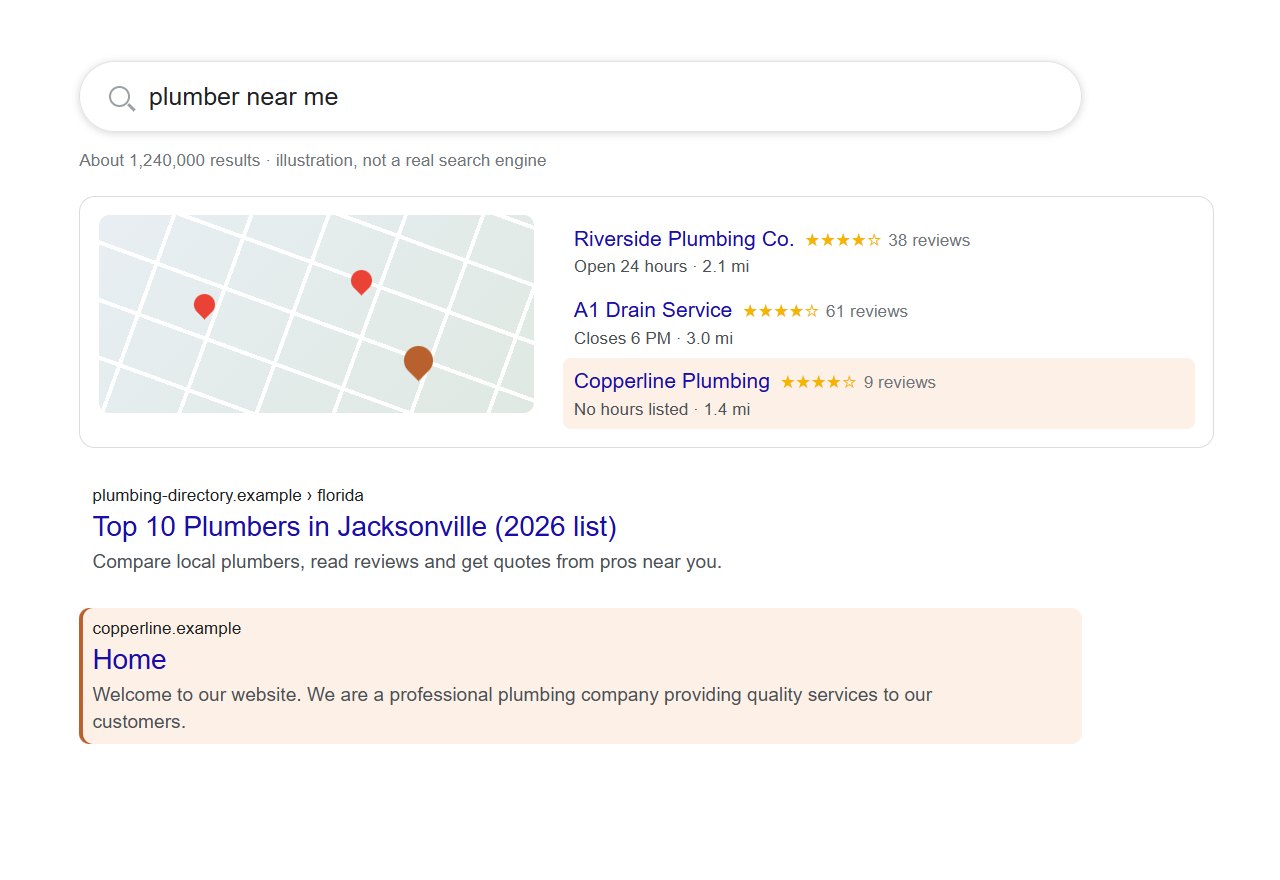
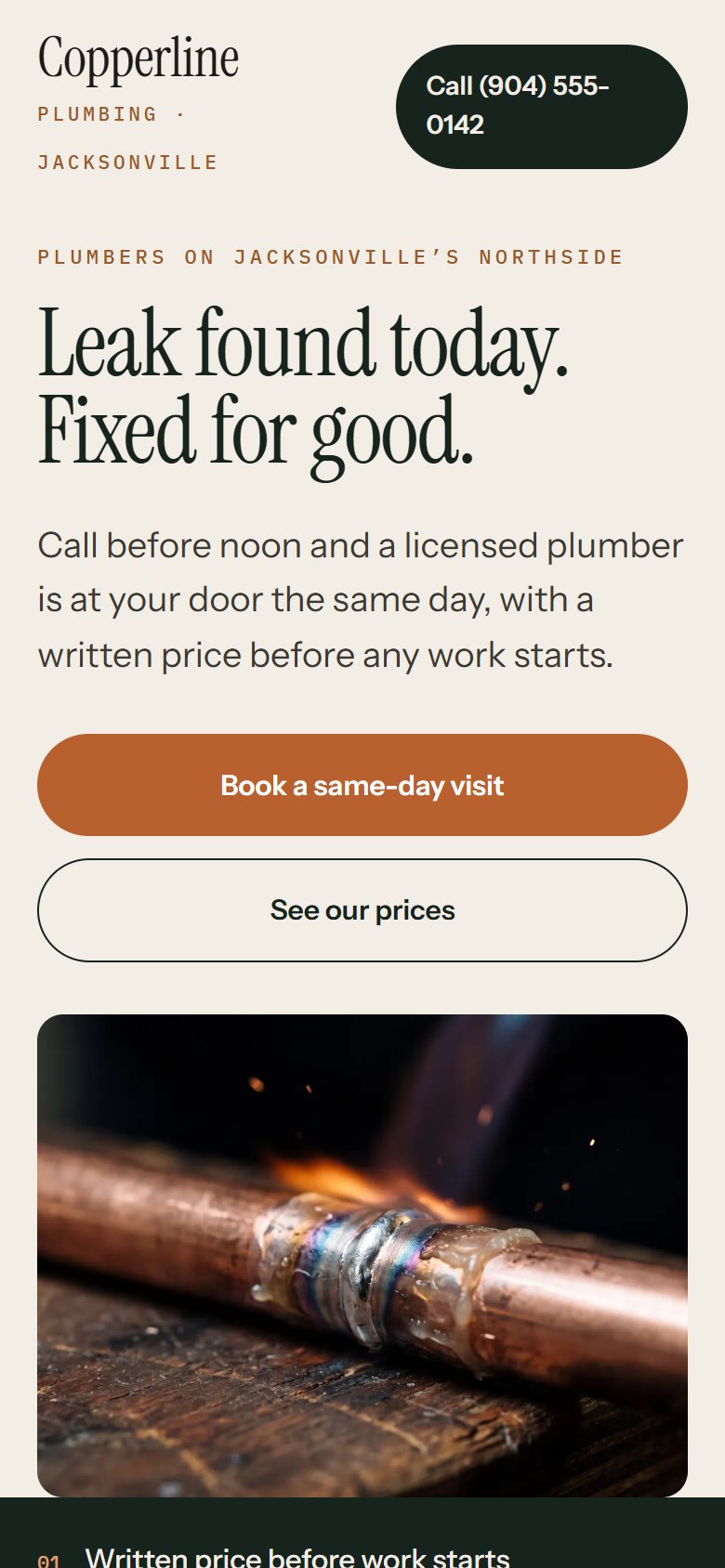
Throughout this guide we will follow Copperline, a made-up plumbing company. It has two possible websites. One is a quick template. The other was built with care. It's the same plumber with the same skills either way, but the two sites give very different odds of being found.
First, it helps to understand what a search engine actually does. Once that is clear, the rest of SEO makes sense.
ii · a crawler following links across town
How Google finds, stores and shows a page
Google's own guide to Search describes three stages: crawling, indexing and serving results. Some pages drop out at each one.
Imagine a phone directory that has to be rewritten every day with no list of businesses to start from. That is roughly Google's problem. No master list of web pages exists, so it keeps hunting for new and changed pages. It finds them by following links from pages it already knows, and from sitemaps that site owners submit.
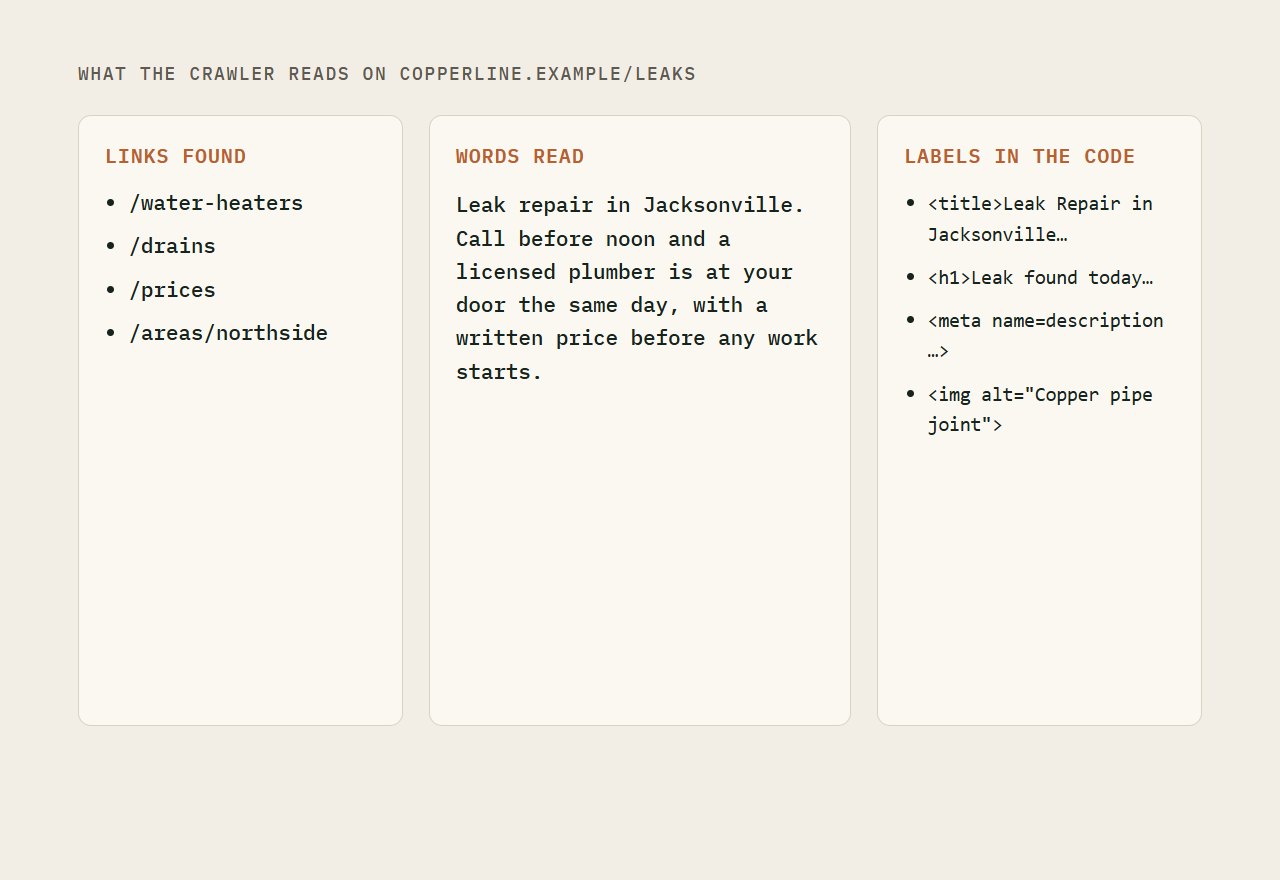
Next comes crawling. Automated programs called crawlers download the text, images and video on each page. Google also runs the page's JavaScript, because many sites load content that way.
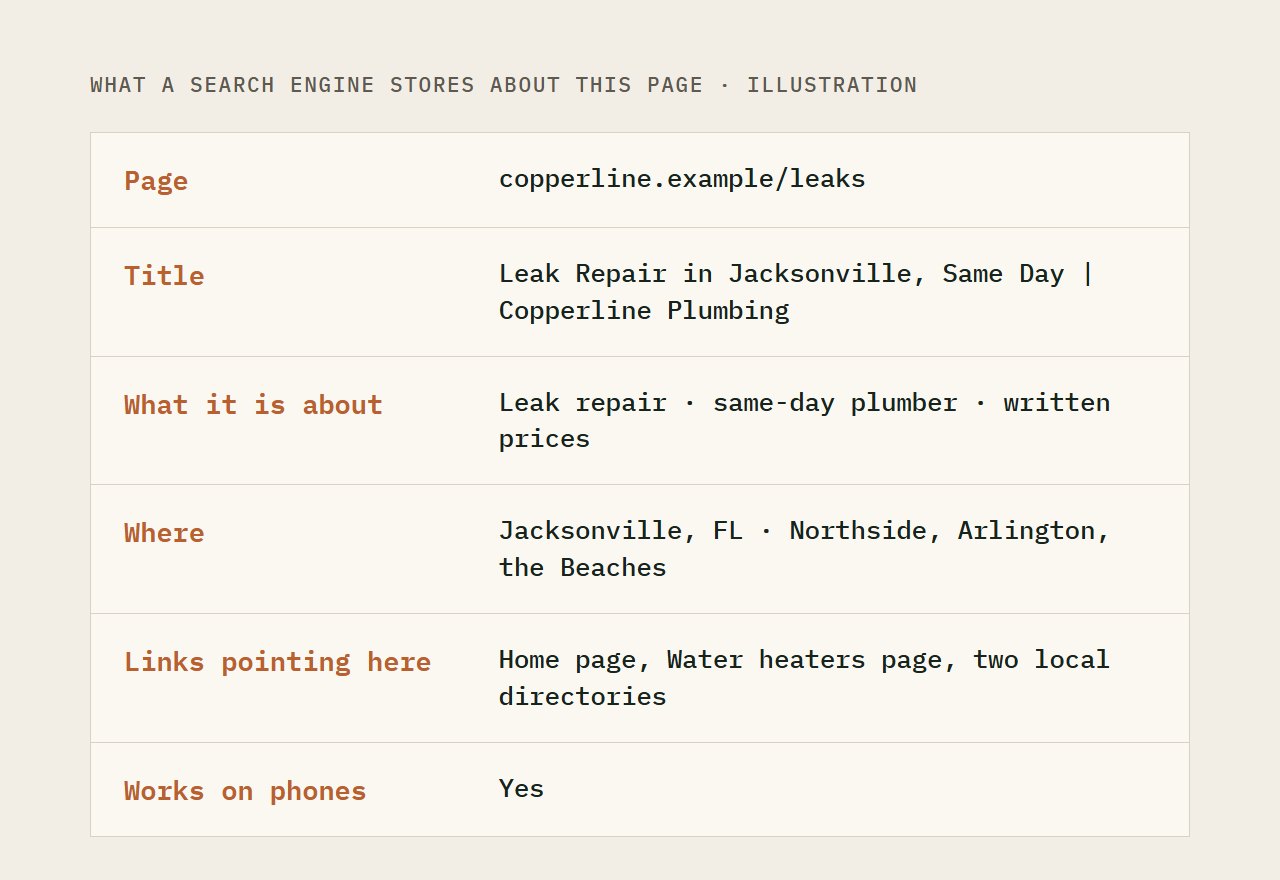
Then comes indexing. Google analyses what it downloaded and stores what it learns in the Google index. Being processed is not the same as being stored, and a processed page may still be left out.
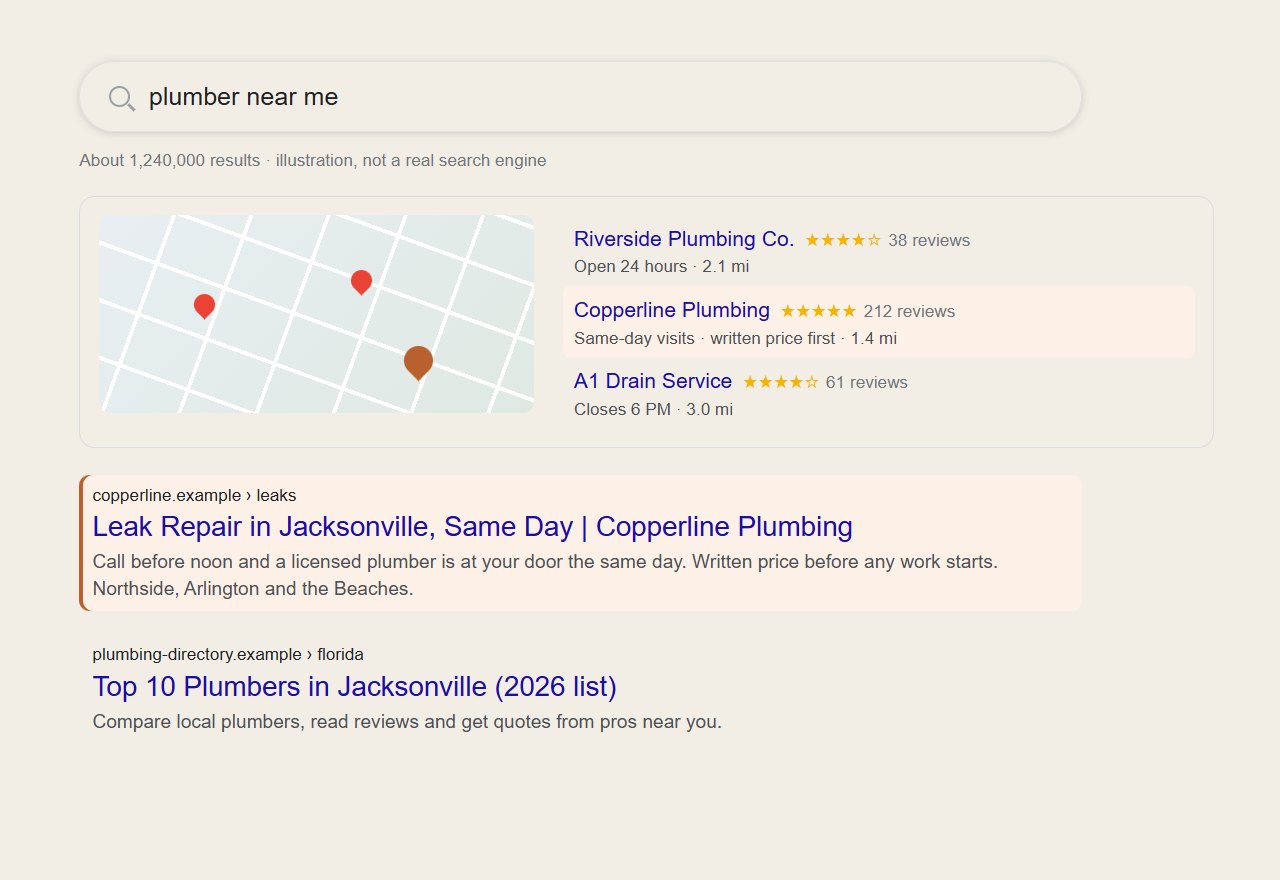
Last comes serving. When someone searches, Google returns the results it judges relevant to their query. That judgement draws on hundreds of factors, including the searcher's location, language and device.
Google finds the page
It follows a link from a page it already knows, or reads the sitemap Copperline submitted.
A crawler downloads it
The words, images and video are downloaded, as long as nothing blocks the way.
The page is run the way a browser would run it
Google runs the JavaScript so it can see any content that loads that way.
What it learned is stored
The topic, title and place go into the index. Some processed pages never make it in.
It appears for a search
When someone nearby searches, Google picks the results it judges relevant to them.
iii · copperline's leak repair page, under the hood
What SEO work can actually change
SEO works on the things that help a page through those three stages. It comes down to two jobs: making the site easy for machines to read, and making the content worth showing.
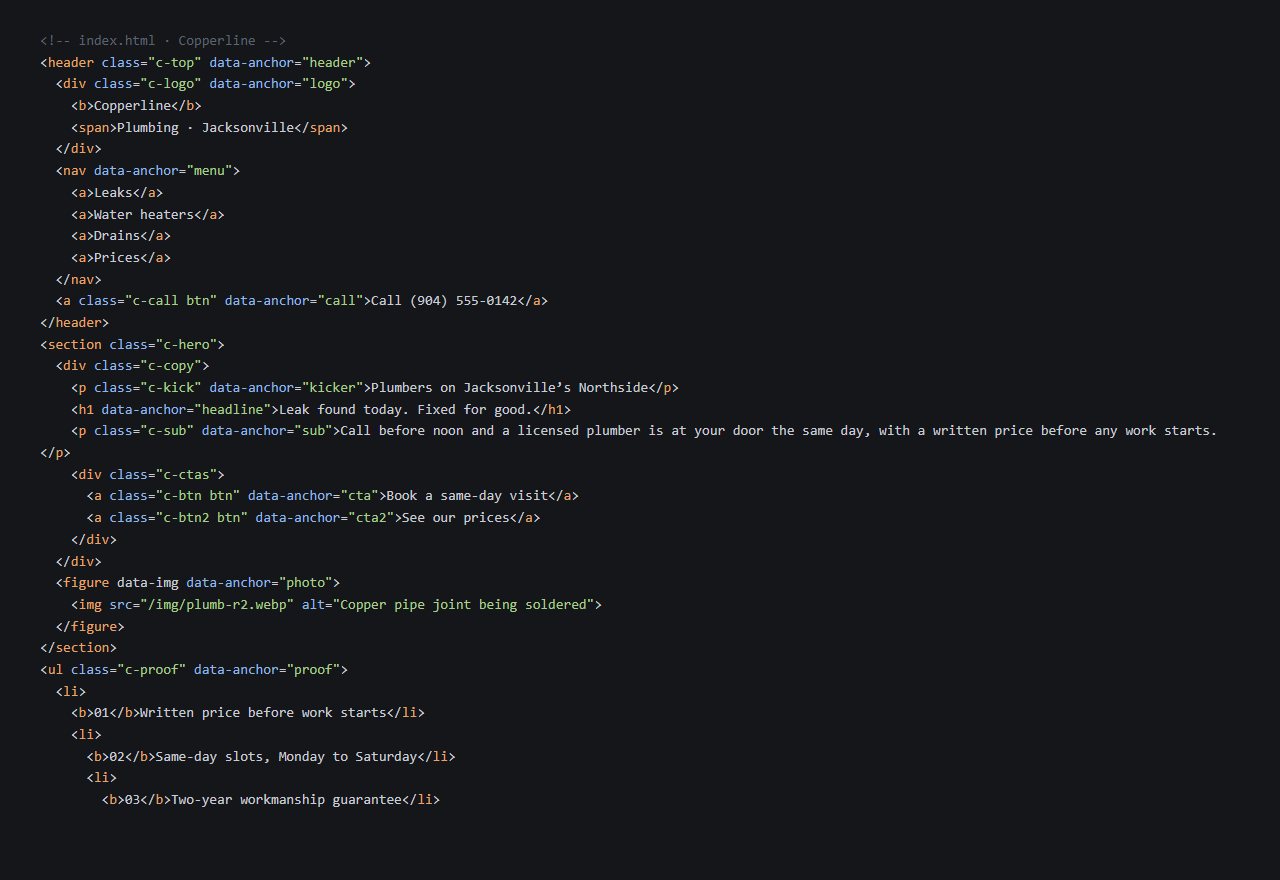
The first job is called technical SEO. Its aim is that search engines can crawl, index, render and understand the site. This matters because Google can only crawl pages it can reach. Server problems, robots.txt rules or login walls can block it.
The second job is content. Search engine bots read all the content they can reach, and the index is built from that. For Copperline, that means a page that says plainly that it fixes leaks, and in which town.
Word choice matters too. More specific keywords are easier to rank for, but fewer people search for them. 'Plumber' on its own is a crowded search. A phrase that names the job and the town reaches fewer people, but it is a race Copperline can realistically win.
Other websites play a part as well. Links from other sites raise the trust search engines place in your content. A local news story or a supplier's page that links to Copperline works like a recommendation from a neighbour.
- 1 · A clear title
It names the service, so the stored record can match what people actually search for.
- 2 · One clear topic
Leak repair, said in plain words the crawler can read.
- 3 · A named place
Location shapes results, so saying where you work gives Google something to match.
- 4 · Links in and out
Links help Google find the page, and links from other sites add trust.
- 5 · Contact details
The name, address and phone number match what is listed in local directories.
iv · a well-built page, still waiting by the phone
What SEO cannot promise
This is where honest advice and sales talk part ways. Google states that even a page that follows its rules is not guaranteed to be crawled, indexed or shown.
Money does not change that. Paying Google cannot buy more frequent crawling or a higher ranking. Organic results are the unpaid ones, so they have to be earned.
A page can also be stored and still never appear. That happens when its content is low quality, or when it does not match what people search for. Michigan Tech makes a similar point: good content brings no traffic on its own, because people have to be searching for that topic.
So think of SEO as improving your odds rather than securing a result. Anyone who guarantees you a top spot is promising something Google itself will not.
For Copperline, the lesson is to keep expectations honest. Build clear pages, make sure Google can reach them, and judge the work by the calls and enquiries that come in.
Copperline's new page follows all of Google's rules. What can it count on?
v · the same search, typed in two different towns
Why SEO matters to a local business
For a business that serves one area, location shapes everything. Google says the same local-service search shows different results in different cities, which is why local visibility matters to a local business.
A homeowner searching for a plumber in Copperline's town sees a different list from someone two cities away. That works in a local firm's favour, because Copperline only has to stand out among the plumbers near its customers.
Local SEO is treated as a separate discipline for exactly this reason. For many companies, SEO as a whole is a central part of digital marketing.
Business sources make a strong case for it, though they write from a marketing point of view rather than from research. HubSpot says SEO brings small businesses organic traffic without paying for ads. Salesforce says a findable website means relying less on paid ads, and that SEO builds credibility.
The other side of that is harder to hear. If a business does no SEO, its competitors may be the only ones that show up. None of these sources gives a cost or a timeframe, and estimates vary, so be wary of anyone who quotes you a firm figure.
Where the searcher is changes the list
Google weighs many factors to decide what is relevant, and the searcher's location is one of them. A plumber whose website never names its town gives Google little to match.
hundreds of factors
decide relevance, including where the searcher is
Three stages, three places to drop out
A page has to be crawled, then indexed, then chosen for a search. Some pages fall out at each stage, so a gap at any one of them can hide a business.
three stages
every page passes through, and some drop out at each
An empty spot gets filled
If Copperline does no SEO, the plumbers who do some may be the only names a nearby customer sees.
Less reliance on paid ads
Organic results cannot be bought. Business sources say a findable website means leaning less on ads.
vi · a cup of coffee and an hour with the website
Your first SEO checklist
You don't need to be technical to take these first steps, and most owners can do them on their own. If you would rather hand them off, here is what professional SEO help covers.
0 of 6 done
vii · Questions people ask
Quick answers
How long does SEO take to work?
None of the sources behind this guide give a timeframe, and estimates vary widely. Since Google guarantees no result, treat any fixed deadline with caution.
Is SEO the same as paying for Google ads?
No. SEO aims at the organic, unpaid results, and paying Google cannot buy a higher organic ranking.
Do I need a sitemap?
It helps. Google finds pages by following links and through sitemaps that site owners submit, so a sitemap gives Google one more way to find your pages.
viii · Where this comes from
References
- In-Depth Guide to How Google Search Works | Google Search CentralGoogle Search Central
- What Is SEO? | Built InBuilt In
- What is SEO? (Search Engine Optimization)Michigan Technological University
- What Is Small Business SEO?HubSpot
- Digital Marketing for Small Business: A Handy Guide | SalesforceSalesforce
We read these sources and explained them in our own words. The plumbing company in the pictures is made up, to show the ideas. This is general information, not legal, tax or financial advice.
 Full frame
Start here
Your business, full frame
A short call, a written plan and a fixed quote before any work starts. Or begin with the free audit and see what we’d change first.